
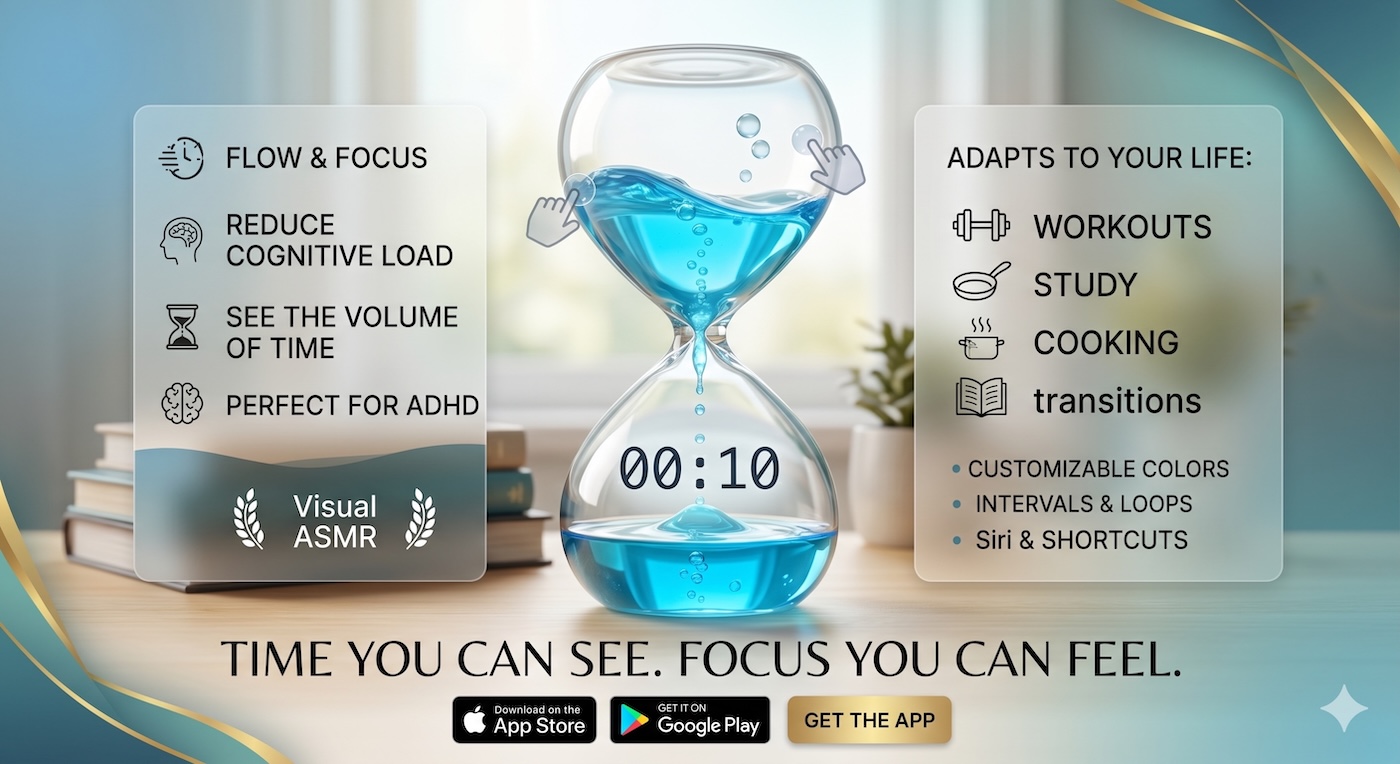
Why Abstract Time Fails ADHD (And What Actually Works)
For most people, seeing "10:45 AM" on a clock provides a sense of where they are in the day. For someone with ADHD, that number is often meaningless. It is abstract. It requires the brain to perform a calculation: "How far is 10:45 from 11:30? How much of an hour has passed?"
For many neurodivergent individuals, this calculation represents a significant "cognitive tax" that leads to mental fatigue.
The Power of Tangible Time
The reason visual timers work where digital clocks fail is that they turn time into something tangible. Instead of a number, you see a volume. You don't have to calculate "how much" is left; you can simply see it. This is why analog clocks (the kind with hands) are often better than digital ones for ADHD, but even they don't show the duration as clearly as a visual timer.
Sensory Feedback for a Busy Brain
The ADHD brain is often under-stimulated. A static clock provides zero stimulation. A visual timer, however, provides a slow, steady stream of visual feedback. This "visual anchor" helps keep the wandering mind tethered to the present moment.
Liquid Time: The Ultimate Fix
Our Liquid Countdown Timer takes tangible time to the next level. By simulating the flow of liquid, it provides a naturalistic representation of time "slipping away." It’s not just a tool; it’s a sensory experience that calms the racing ADHD mind while providing the structure it needs.
Stop fighting abstract numbers and start seeing time. Try our liquid visualization on the homepage.