What Brain Scans Tell Us About Time Perception and Visual Cues
Modern neuroscience uses functional magnetic resonance imaging (fMRI) to see exactly which parts of the brain activate during specific tasks. When researchers look at how we perceive time, the results heavily favor visual representations.
Bypassing the Language Centers
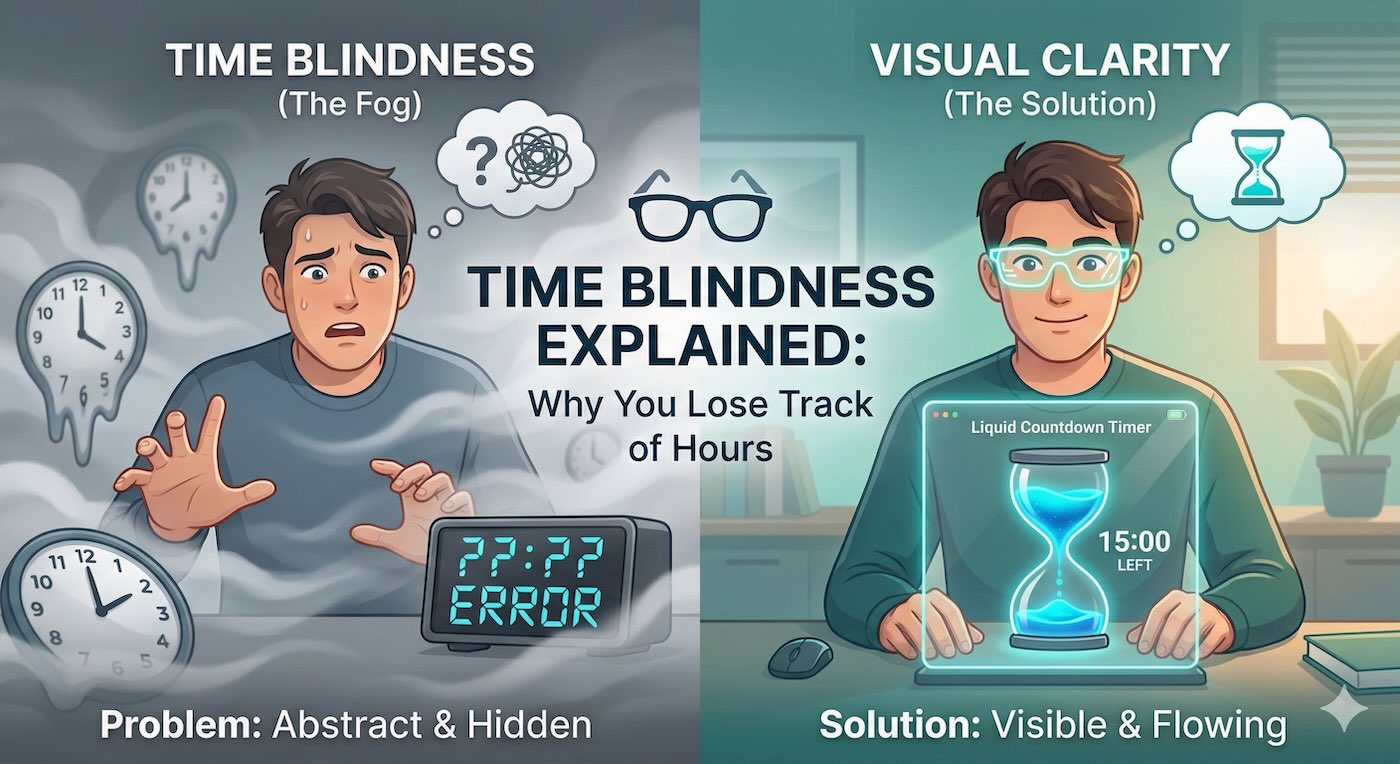
Processing a digital time (like "14:32") activates the brain's language and numerical processing centers. It's an abstract concept that must be decoded. Processing a visual timer, however, activates the spatial processing centers in the parietal lobe.
The Efficiency of Spatial Perception
Spatial perception is older and faster in evolutionary terms. We are wired to understand the size and shape of objects instantly. Visual timers hijack this efficient neural pathway, allowing us to understand "how much time is left" with significantly less mental effort.
Why Liquid Countdown Timer?
The Liquid Countdown Timer leverages your brain's natural preference for spatial data. By turning time into a visible volume of liquid, we bypass complex mental decoding, giving you an effortless, intuitive grasp of your day.
Experience effortless time tracking on our homepage.