
The Neuroscience of Visual Timers in Executive Dysfunction
Executive dysfunction is a hallmark of many neurodivergent conditions, including ADHD and Autism. It affects the ability to initiate tasks, sustain attention, and manage transitions. Interestingly, neuroscience shows that visual timers can bypass some of the neural bottlenecks associated with these challenges.
Bypassing the Prefrontal Cortex
The prefrontal cortex is the area of the brain responsible for high-level planning and time management. In individuals with executive dysfunction, this area may be underactive. Visual timers shift the burden of time-tracking to the visual and spatial processing centers in the posterior part of the brain.
By transforming a "management" task into a "perception" task, visual timers allow the brain to process time more efficiently and with less effort.
Reducing Transition Anxiety
For many neurodivergent individuals, "switching gears" is physically and mentally painful. This is often because the end of the current activity feels sudden and unpredictable. A visual timer provides a continuous, predictable countdown. As the liquid drains, the brain is subconsciously prepared for the upcoming change, significantly reducing transition anxiety and the "shock" of an alarm.
A Scientific Approach to Focus
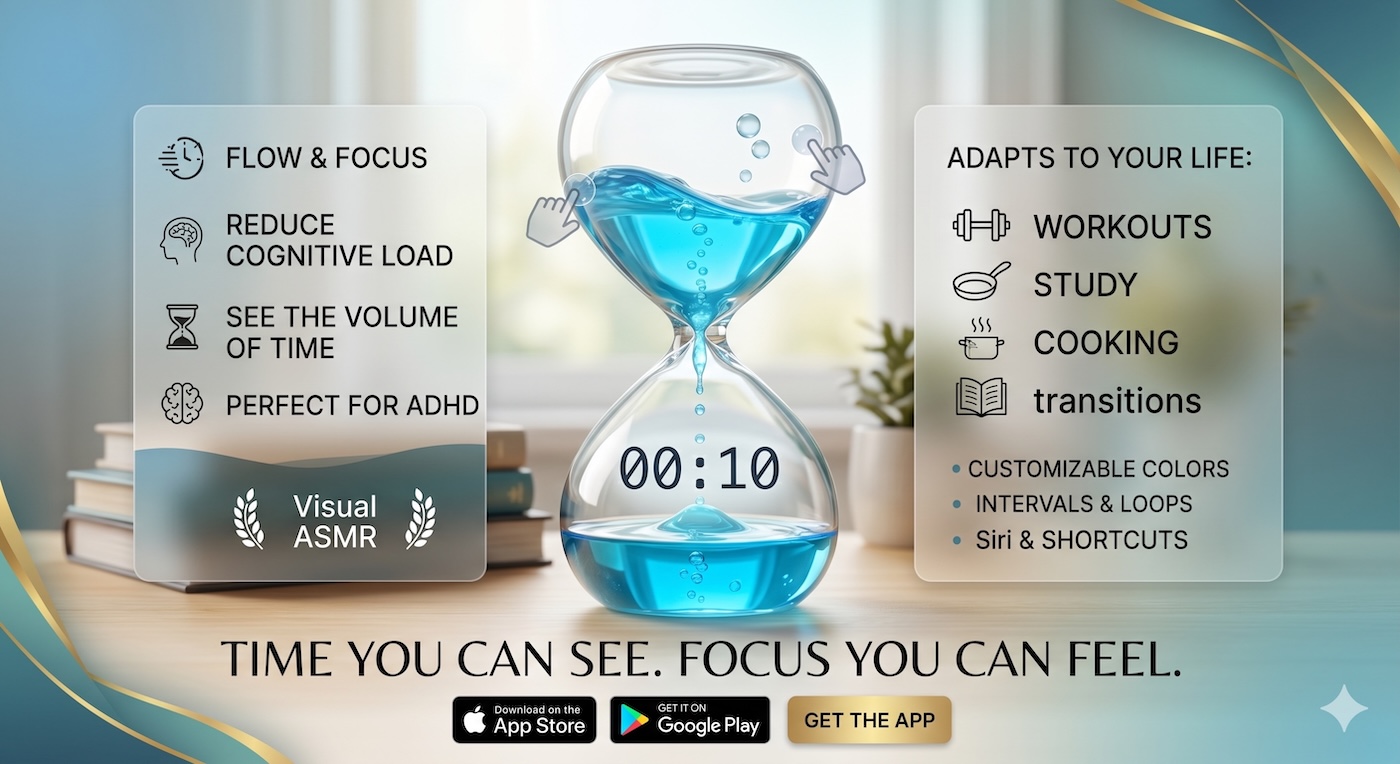
Our Liquid Countdown Timer leverages these neurological principles to provide a superior focus experience. The smooth, gravity-driven animation of the liquid mirrors natural processes, which is more easily integrated by the human brain than the artificial jumping of digital digits.
By using our timer, you aren't just managing your time—you are working with your brain's natural architecture.
Experience the science of focus for yourself by visiting our homepage.