Time Blindness Explained: Why You Lose Track of Hours
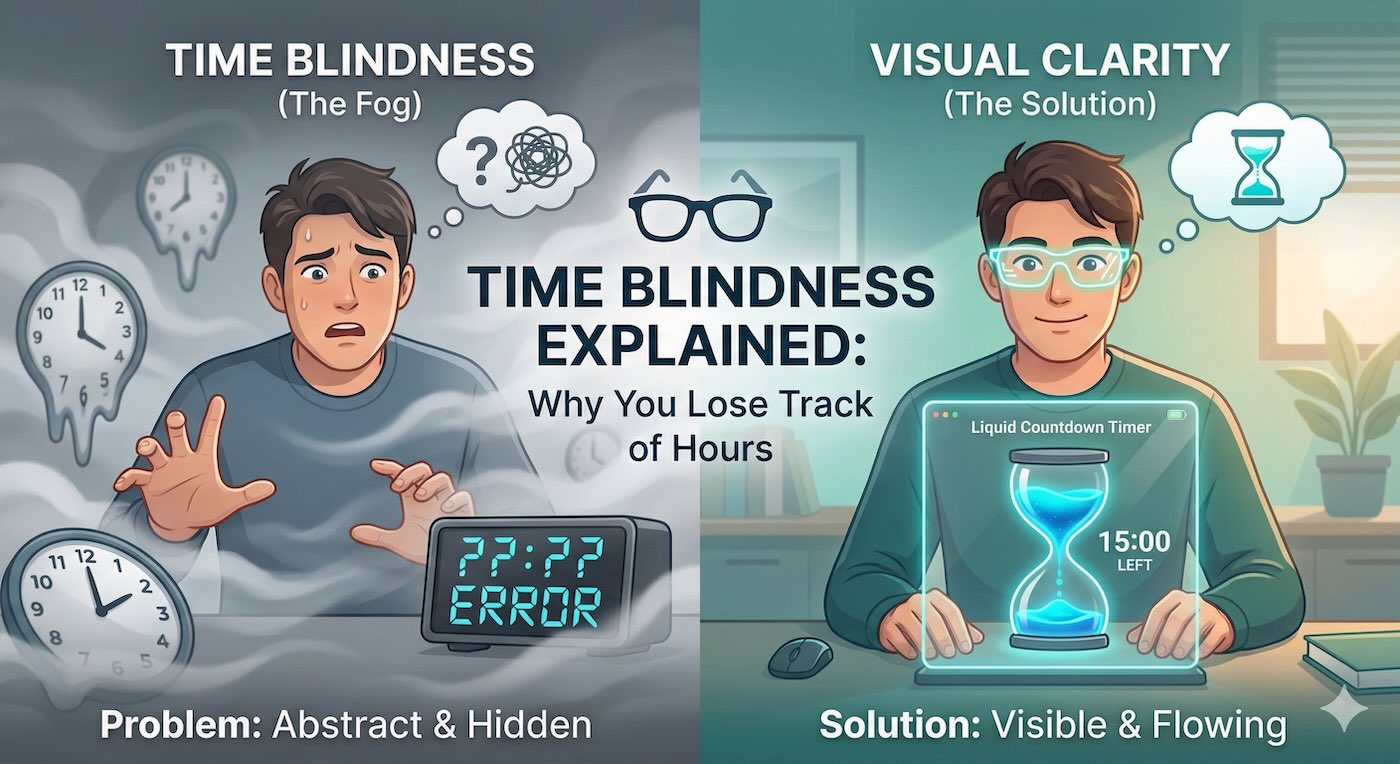
Have you ever sat down to check your email for "five minutes," only to look up and realize two hours have passed? Or maybe you constantly underestimate how long it takes to shower and get dressed?
You aren't lazy, and you aren't "bad" at being an adult. You might be experiencing a very real phenomenon called Time Blindness.
Most people have an internal clock—a "sense" that tells them roughly how much time has passed without looking at a watch. This is just like your sense of balance or your sense of temperature.
For many people (especially those with ADHD, Autism, or high stress), this internal sense is muted or missing.
Think of it like being near-sighted. If you have poor vision, you can’t just "try harder" to see clearly. You need glasses. Similarly, if you have Time Blindness, you can't just "try harder" to be on time. You need a tool to make time visible.
When you have Time Blindness, a standard digital clock is often useless. Why?
Visual timers solve this problem by turning time into a physical object. Instead of reading a number, you see a quantity—like gas in a fuel tank.
Our Liquid Countdown Timer was built to be the ultimate prosthetic for Time Blindness. We don't just show a pie chart; we simulate liquid physics.
You can try the web version of our timer right now on your computer screen without downloading anything. Just visit our homepage.